Structural steel connections: bolted vs welded joints explained
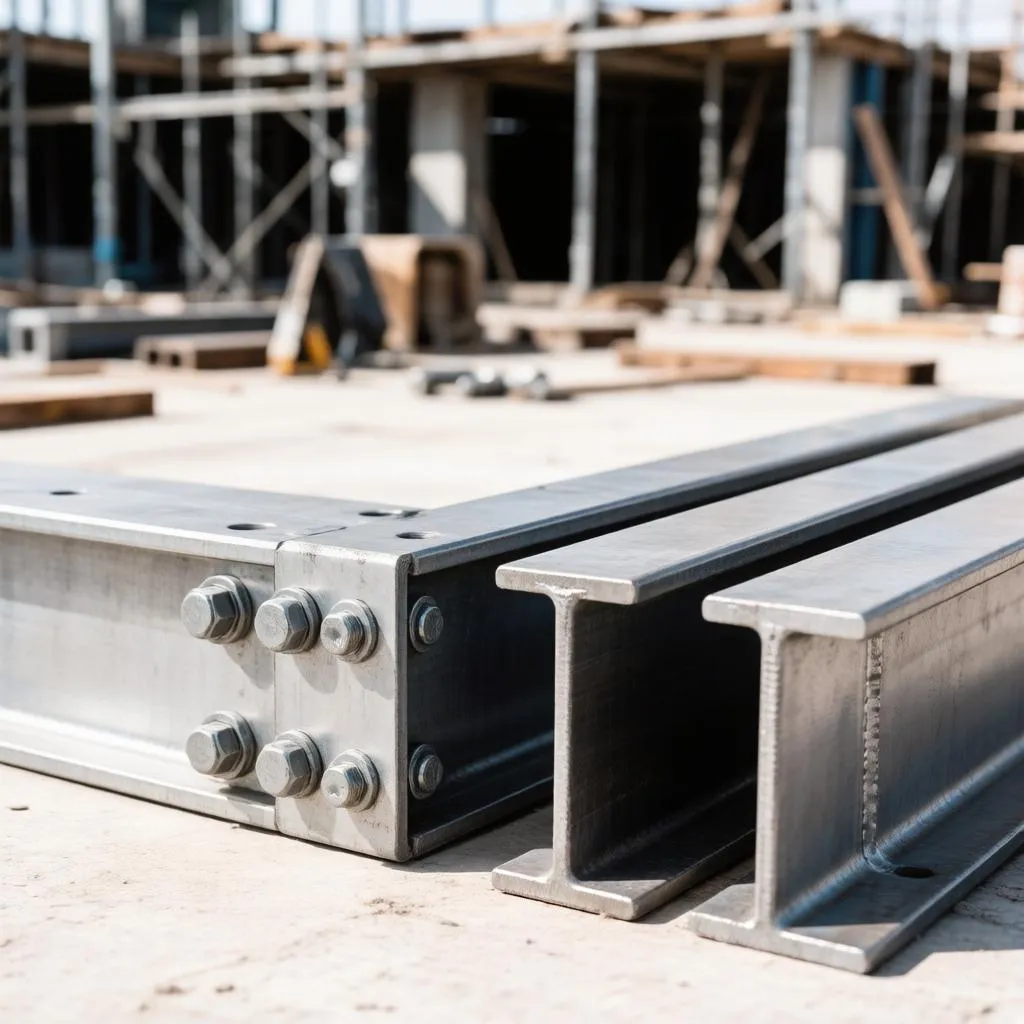
Every steel structure, from a garden workshop frame to a high-rise tower, is only as strong as the joints that hold its members together. The choice between bolting and welding is one of the earliest and most consequential decisions in structural steelwork, shaping cost, programme, inspection requirements and even how the building behaves under load. Both connection types are fully established, both are covered by British Standards, and both are used on the same sites every day — but they suit different tasks, and the reasons go deeper than habit. Understanding how each connection actually works, where it excels and where it creates problems turns the choice from a matter of preference into a matter of engineering judgement.
How the two connection types work
A bolted connection clamps steel members together using high-strength bolts — in modern UK practice almost always high-strength friction grip bolts — which transfer load primarily through friction between the clamped surfaces. The bolt itself holds the plates together under enormous tension, and shear between the members is resisted by the friction generated at the interface. Some connections, known as bearing-type, allow the bolt shank to carry shear directly, but the friction principle underlies most structural bolting today.
A welded connection, by contrast, fuses the parent metals into a single continuous structure. Filler material of matching grade is melted together with the base steel, and when it cools, the joint is theoretically as strong as the members it joins. Welding can transfer moments and forces in ways that bolted joints sometimes struggle to match, and it produces a connection that adds almost no visual bulk — a significant benefit in exposed architectural steelwork.
The philosophical difference between the two is worth stating plainly. Bolting assembles a structure; welding makes it. Bolted joints are discrete mechanical components installed in place, while welded joints become part of the steel itself. Everything about their practical behaviour — installation, inspection, failure modes, reversibility — follows from that single distinction.
Where each connection type fits
Neither type is universally better, and successful projects use both. The strengths of each are worth listing explicitly, because they map directly onto project requirements.
Bolted connections offer:
- Fast site erection with no hot work, weather windows or specialist welders required on site.
- Easy, complete quality verification — bolt torque and fit-up can be checked visually and mechanically by anyone competent.
- Full reversibility, allowing structures to be dismantled, modified, extended or relocated.
- Predictable, repeatable performance from factory-controlled components.
- Simpler temporary works during erection, since members can be supported and adjusted before final tightening.
Welded connections offer:
- Maximum joint efficiency, with the connection achieving the full strength of the joined members.
- Clean, streamlined appearance with no protruding bolt heads or plates, valued in exposed steelwork.
- Superior performance in fatigue-critical and moment-resistant applications.
- Freedom from connection geometry constraints, allowing complex member arrangements.
- No requirement for additional connection material in many simple joints, saving weight.
The lists explain why multi-storey buildings are predominantly bolted on site — speed, safety and inspection dominate — while bridge girders, crane gantries and machine frames lean toward welding, where fatigue and moment transfer justify the additional effort. Practical UK practice frequently splits the difference: members are fabricated and welded in the workshop, then bolted together on site, combining factory welding quality with site erection speed.
Performance, cost and practicality compared
A direct comparison across the factors that actually drive project decisions makes the trade-offs concrete. The values reflect typical UK practice rather than absolute limits.
| Factor | Bolted connections | Welded connections |
|---|---|---|
| Site installation speed | Fast, all-weather capable | Slower, weather and access dependent |
| Initial cost per joint | Moderate; drilling and hardware | Higher; skilled labour and preparation |
| Quality verification | Simple torque and visual checks | Requires qualified welders and NDT testing |
| Fatigue resistance | Good; friction-grip design performs well | Excellent; monolithic behaviour |
| Strength relative to parent steel | Slightly reduced by plate thickness | Full parent metal strength |
| Modification and dismantling | Fully reversible | Effectively permanent |
| Appearance in exposed work | Visible plates and bolt heads | Seamless, clean lines |
| Tolerance accommodation | forgiving of site tolerances | demands accurate fit-up before welding |
Two rows deserve particular attention. The inspection row is where welding’s hidden costs concentrate: every structural weld requires qualified welders, welding procedure specifications and non-destructive testing such as ultrasonic or magnetic particle inspection, all of which add cost and time that bolted connections avoid entirely. The tolerance row is the reverse side of the same coin — welded joints demand precision that bolted holes generously absorb, which is why site welding on poorly prepared steel is one of the most common sources of defects in the industry.
Common joint types in practice
Both connection families contain several distinct arrangements, and knowing the main types clarifies how designers deploy each method.
- Bolted simple (shear) connections. End plates or fin plates transferring vertical shear only, used at beam-to-column joints in most multi-storey frames.
- Bolted moment connections. Extended end plates with top and bottom cleats, transferring bending moments where continuous frames are required.
- Bolted splice connections. Cover plates joining sections end to end, standard for splicing long columns and beams into transportable lengths.
- Butt welds. Full-penetration welds joining members face to face, delivering parent-strength continuity for splices and critical load paths.
- Fillet welds. Triangular welds along member intersections, the workhorse weld type covering the majority of fabricated joints by volume.
- Welded moment connections. Full-penetration welds with stiffeners at beam-to-column junctions in moment-resisting frames.
The two families are not competing philosophies but complementary toolsets, and most real structures draw from both. A typical steel-framed building uses welded sub-assemblies fabricated in the workshop, bolted together on site, with welding reserved for the handful of joints where its strength and continuity genuinely add value.
Failure modes and what inspection actually checks
Understanding how each connection can fail explains why inspection regimes differ so sharply between the two types.
Bolted connections fail in recognisable, inspectable ways: bolt shear, plate bearing failure, block shear through the bolt group or slippage of the friction interface. Each mode is visible or measurable, and a bolt that has loosened or a plate that has deformed can be identified by straightforward examination. This inspectability is bolting’s greatest safety advantage — problems announce themselves before they become critical.
Welded connections fail through the weld itself, and the critical defects — lack of fusion, internal cracking, porosity, slag inclusion — are invisible from the surface. A weld can look perfect while containing a flaw that grows under repeated load until sudden failure occurs. This is the entire reason structural welding carries its infrastructure of welding procedures, qualified welders and non-destructive testing. A fillet weld on a minor connection may escape detailed inspection; a full-penetration butt weld in a primary load path demands full NDT coverage. Neither approach is careless — both simply match scrutiny to consequence.
Fatigue behaviour deserves its own note. Repeated load cycles — traffic on bridges, machinery on plant structures — damage connections cumulatively, and welded joints are inherently more sensitive to fatigue because weld geometry creates stress concentrations. Bolted friction-grip connections perform well under fatigue because load transfer through friction avoids the notch effect entirely. For structures with heavy cyclic loading, this difference frequently decides the connection type on its own.
Choosing the right connection for the job
The decision framework resolves into a few project-level questions. Is the structure likely to be modified, extended or relocated during its life? If yes, bolting dominates. Does the connection carry significant bending moments or sit in a fatigue-critical load path? If yes, welding earns its cost. Is the steelwork architecturally exposed? Welding or concealed bolted details come into play. Is site welding practical given access, weather and the availability of qualified welders? If not, bolted site connections are the pragmatic answer regardless of other preferences.
Budget and programme considerations complete the picture. Welding concentrates cost into skilled labour and inspection, while bolting spreads cost into drilling, plates and hardware. A project with a tight programme and a standard frame configuration benefits from maximising bolting; a project with unusual geometry, demanding load paths or architectural exposure justifies the welding investment where it matters. The most expensive mistake is neither method in isolation but using the wrong one for the wrong joint — welding where speed and reversibility were needed, or bolting where continuity and fatigue performance were the deciding factors.
Two methods, one integrated approach
Bolted and welded connections are not rivals so much as two answers to the same question, each optimal in its own territory. Bolting delivers speed, inspectability and reversibility at a predictable cost, which is why it dominates site erection across the UK construction industry. Welding delivers continuity, strength and elegance, which is why it dominates fabrication and the joints where structural performance is most demanding. The projects that succeed are the ones that treat the choice as an engineering decision made joint by joint, rather than a preference declared once for the whole structure. Read the load path, weigh the programme and the access, and the connection type usually selects itself.