MIG vs TIG vs submerged arc welding: choosing the right process for structural steelwork
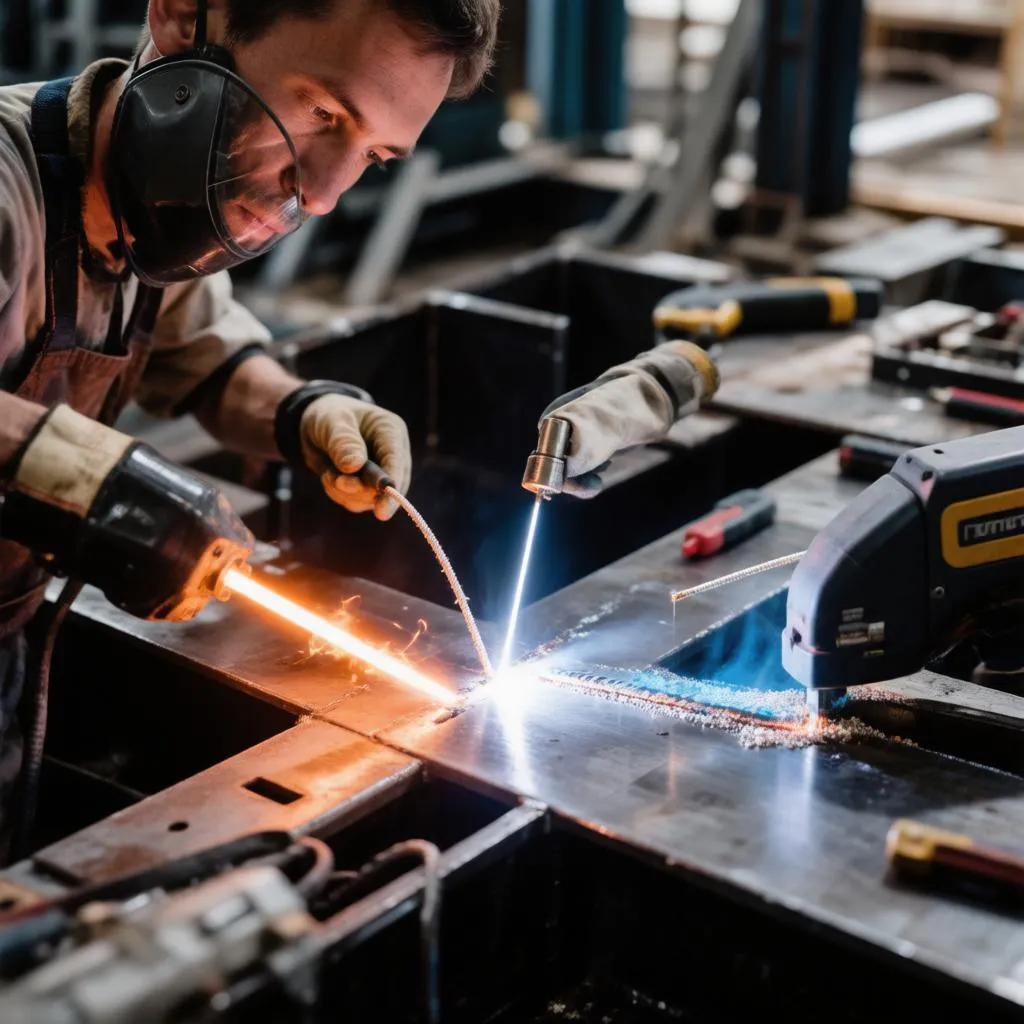
Every fabrication shop eventually faces the same question on the shop floor: which welding process should carry the load on this job? The three contenders for structural steelwork — MIG (GMAW), TIG (GTAW) and submerged arc welding (SAW) — are not interchangeable tools in a toolbox. They represent three different trade-offs between speed, quality and cost, and choosing the wrong one shows up either as a blown schedule or as a repair bill that eats the margin on the entire contract. A fabricator who TIG-welds hundreds of metres of plate girder will go out of business before the first frame ships; one who runs submerged arc on thin-sheet brackets will spend more time cleaning up the mess than welding.
The right answer is rarely «one process for everything». Real structural shops use all three, assigned by joint type, material thickness, position and the code the work must satisfy. Understanding where each process wins — and where it quietly loses money — is what separates a well-run fabrication operation from an expensive one. What follows is a practical comparison: how each process works, what it costs to run, where it belongs on structural work, and the decision logic that ties it together.
How each process actually works
Before comparing outputs, the fundamentals — because the practical differences all flow from the physics of each arc. The three processes in brief:
- MIG (GMAW). A continuously fed wire electrode melts under a shielding gas, typically argon–CO₂ mixtures for steel. It is the workhorse of fabrication: fast, forgiving, easy to train operators on, and compatible with semi-automatic or mechanized setups. Its weaknesses are spatter, sensitivity to wind when welding outdoors, and penetration that depends heavily on settings and technique.
- TIG (GTAW). A non-consumable tungsten electrode under pure argon shielding, with filler added by hand or a cold-wire feeder. It produces the cleanest, most controllable arc of the three and beautiful, spatter-free welds — at deposition rates so low that it is economically viable mainly on thin sections, root passes, pipe and detail work where appearance and precision justify the time.
- Submerged arc (SAW). A continuously fed wire — sometimes two or more — burns beneath a blanket of granular flux that melts and covers the pool. The arc is invisible, the weld is laid down in enormous quantities, and deposition rates can reach an order of magnitude beyond manual processes. It is almost exclusively a mechanized process: gantries, booms and fixtures feed the work through the arc. Its limitations: it only works flat or horizontal, and it is impractical below roughly 6 mm thickness.
The shielding approach also explains the practical boundaries. TIG’s argon blanket is easily disturbed by draughts; MIG’s gas shielding struggles outdoors without wind barriers; SAW needs no gas at all because the flux blanket does the protection — which is part of why it thrives in heavy shops and not on site.
The head-to-head comparison
The numbers tell the story faster than prose. Typical values for carbon steel in shop conditions:
| Parameter | MIG (GMAW) | TIG (GTAW) | Submerged arc (SAW) |
|---|---|---|---|
| Deposition rate | ~2–5 kg/hr (wire-dependent) | ~0,5–1,5 kg/hr | ~5–20+ kg/hr |
| Typical thickness range | 1 mm and above | Up to ~6 mm practical | 6 mm and above |
| Position capability | All positions | All positions | Flat and horizontal only |
| Weld appearance | Good; some spatter | Excellent; spatter-free | Good; flux must be cleaned |
| Operator skill required | Moderate | High | Low to moderate (machine-focused) |
| Typical relative cost per metre of sound weld | Medium | High | Low on heavy section |
| Suitability for site work | Good with precautions | Possible but rarely economic | Essentially shop-only |
The table explains why most structural shops treat these as complementary rather than competing processes. SAW lays down the tonnes on heavy plate and long seams; MIG handles everything else at speed; TIG is reserved for the jobs where control and finish matter more than throughput. A shop that runs all three and assigns them correctly will beat one that runs any single process on every job.
Where each process belongs on structural work
Assigning processes to joints is the practical skill. The typical allocation on a structural contract:
- Plate girders, box sections and heavy columns — SAW. Long, continuous flat welds on material 8 mm and thicker are the natural habitat of submerged arc: deep penetration, high deposition, consistent quality pass after pass. Double-wire and tandem setups push throughput further on heavy marine and bridge work.
- Connections, fittings, stiffeners and repair — MIG. The majority of weld metal on a typical structural job is applied by MIG: fillet welds on connections in all positions, short seams, brackets, and any work where mechanization does not pay. Pulsed transfer on modern machines also extends MIG’s range into thinner gauge and out-of-position work with good control.
- Root passes on pipe, stainless and precision details — TIG. On pressure pipe, the TIG root pass gives the clean, fully penetrating start that subsequent MIG or SAW fills efficiently. On stainless architectural work and on welds requiring cosmetic finish, TIG is often specified outright.
This allocation logic also answers the question of single-process shops: a small fabricator doing light-to-medium structural work can run MIG almost exclusively, adding TIG capability for pipe and detail; SAW enters the picture only when long heavy welds justify the mechanization investment. The capital cost of an SAW line — boom, column, flux recovery, positioner — is significant and only pays for itself on volume.
Quality, codes and the things that bite
Weld quality in structural work is governed by codes and inspection, and each process carries its own characteristic defects. Knowing them shapes the choice as much as the deposition numbers do:
- MIG: the classic risks are lack-of-fusion in high-speed settings, porosity from poor gas coverage and draughts, and spatter that adds grinding labour. Proper transfer-mode selection (spray, pulsed) and disciplined gas coverage control most of it.
- TIG: the defect profile is small — its risk is more about speed than quality. Tungsten inclusions and contamination from poor prepping are the classic faults; otherwise TIG produces the most inspectable, consistent welds of the three.
- SAW: solidification cracking on high-dilution passes, and slag traps if interpass cleaning is sloppy. Flux handling — storage, recycling, correct granule condition — is a real operational discipline, and Moisture in flux is a genuine cause of porosity.
Under most structural codes, all three processes are prequalified for carbon steel when the welding procedure specification is followed. The procedure — WPS with qualified parameters, welder qualifications, inspection points — is where quality is actually decided; the process choice determines how much of that paperwork weight each metre of weld must carry.
The economics: where the money actually goes
Cost-per-metre comparisons frequently mislead because they compare arc-on time and ignore everything around it. A realistic economic picture includes:
- Consumables. MIG wire is inexpensive; TIG filler costs more per kilo and deposition is slow, so consumable cost per metre of weld is highest on TIG. SAW flux and wire are cheap per deposited kilo — the economics improve dramatically with joint thickness.
- Labour hours. This is the dominant cost in manual welding. A MIG welder lays down several times the metal of a TIG welder in the same hour; SAW multiples that again. On a heavy girder, the labour difference between processes can be a factor of ten.
- Post-weld treatment. Spatter grinding, flux chipping and cleaning are real hours. TIG wins on post-weld labour; SAW requires disciplined flux handling; MIG sits in between, with pulsed settings reducing the cleanup load.
- Capital and mechanization. SAW demands the largest upfront investment in mechanized equipment; TIG needs skilled labour rather than capital; MIG sits in the middle. A shop’s existing equipment and workload profile should drive the choice as much as the theoretical numbers.
The conclusion most fabricators reach: for structural steel with meaningful volume, the marginal weld should be MIG, the heavy long-seam work should be SAW where thickness allows, and TIG should be defended as a specialist tool rather than a general one. Shops that let TIG creep into production welding pay for the mistake in delivery dates.
A practical decision path
When a new job arrives, the allocation decision follows a short sequence. The logic in order:
- Start with thickness. Under 6 mm, SAW is off the table. Over about 12 mm on long seams, SAW usually wins outright.
- Then position. Vertical, overhead or site welds push the choice toward MIG; flat-and-horizontal mechanized welds open the SAW door.
- Then joint length. Short, interrupted welds favour MIG regardless of thickness; continuous metres of weld favour mechanization.
- Then quality requirement. Cosmetic or precision-critical work justifies TIG despite the time; pressure-pipe roots almost always do.
- Then the code and inspection plan. Whichever process the qualified procedures cover with the least qualification burden is often the cheapest overall choice.
Run through this sequence, most structural jobs resolve into a mix — and a shop that plans the mix up front, rather than letting each welder choose by habit, captures the savings that the process selection actually offers.
Conclusion
MIG, TIG and submerged arc welding are not rivals so much as three gears in the same gearbox — and structural fabrication runs best when each is used where its physics and economics align. MIG is the volume tool for everything in every position; TIG is the precision tool for roots, thin sections and finish; SAW is the production tool that pays for itself on heavy plate and long seams, and nowhere else.
The choice, in practice, is made at the estimating stage, not the welding stage: joint thickness, position, seam length and code requirements should determine the process assignment before the first weld is struck. Get that allocation right and the same three machines deliver a faster shop, fewer repairs and a margin that survives the contract. Get it wrong, and the most expensive weld on any job is the one made with the wrong process for the work — a mistake that no amount of operator skill can recover.