Culvert replacement on UK highways: environmental permits, EA approval and fish passage requirements
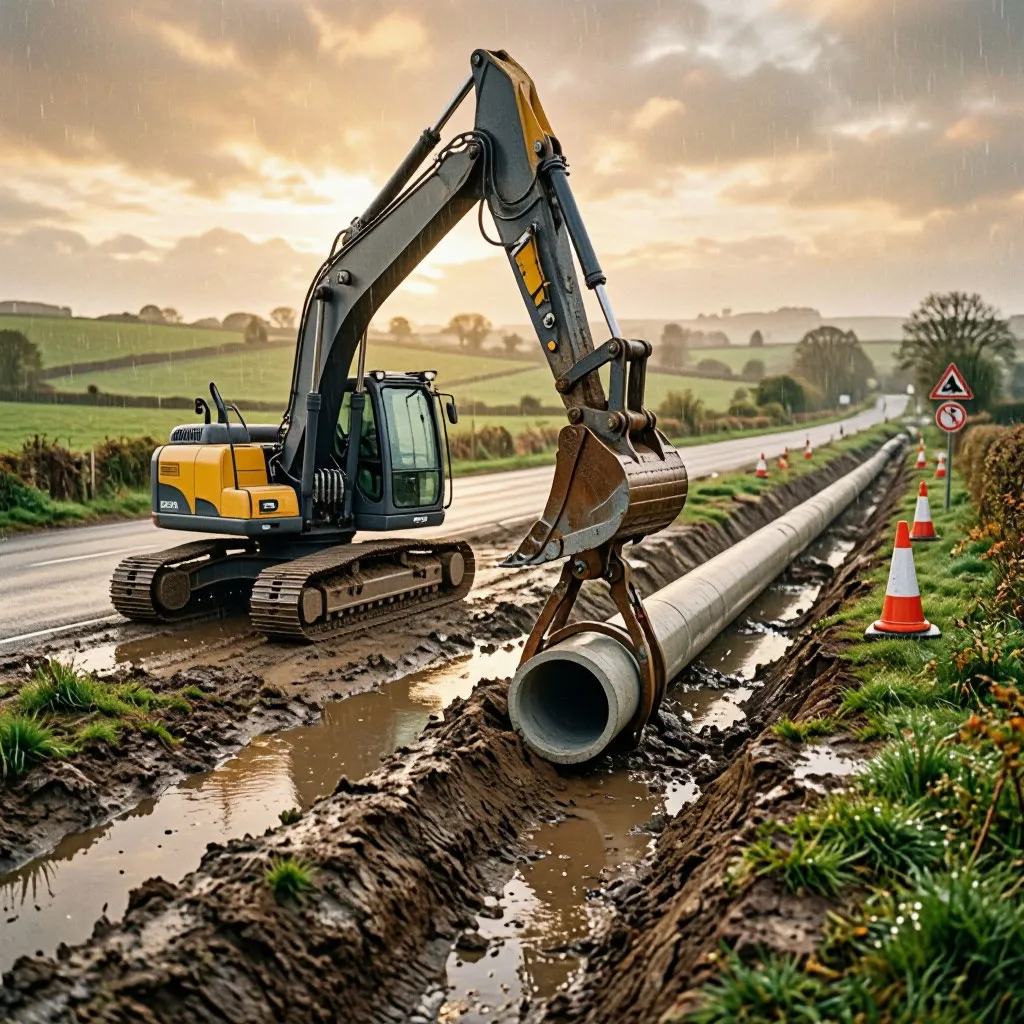
Replacing a culvert sounds like straightforward civil engineering: dig out the old structure, drop in a new one, backfill, pave. On paper, a typical highway culvert replacement takes two to three weeks of construction work. In reality, the same project often requires twelve to eighteen months of preparation before a single shovel touches the ground — and most of that lead time is consumed not by structural design or traffic management planning, but by environmental regulation. The culvert sits in a watercourse, the watercourse supports (or once supported) aquatic life, and the legal framework protecting that aquatic life in England and Wales is layered, prescriptive, and enforced with increasing rigour.
The Environment Agency, Natural England, the Lead Local Flood Authority, and sometimes Internal Drainage Boards all have statutory powers over what happens in, around, and above a watercourse. A culvert replacement that ignores or underestimates these powers risks enforcement notices, project delays measured in months, and in serious cases, prosecution under the Environment Act 2021 or the Salmon and Freshwater Fisheries Act 1975. For highway authorities, contractors, and consultants involved in culvert schemes, understanding the regulatory landscape is not optional due diligence — it is the critical path.
Why culvert replacement has become environmentally sensitive
The UK has approximately 240,000 culverted watercourse crossings on its highway network, and the majority were installed decades ago with no consideration for fish passage, sediment transport, or habitat continuity. Many are perched — their outlets sit above the downstream water level, creating a drop that fish cannot negotiate. Others are too steep, too narrow, or too long, creating velocity barriers that prevent upstream migration during normal flows. The cumulative effect is fragmentation: rivers and streams sliced into isolated segments where fish populations cannot move to spawn, feed, or recolonise after pollution events.
This fragmentation is now a central concern for the Environment Agency and for conservation bodies because several species of fish — Atlantic salmon, European eel, brown trout, and brook lamprey — have experienced dramatic population declines. Atlantic salmon are now classified as endangered by the IUCN, and the European eel is critically endangered. The Eel Management Plans required under EU regulation (retained in UK law post-Brexit) mandate the removal of barriers to eel migration, and culverts are identified as one of the most widespread and impactable barrier types. When a highway authority proposes to replace a culvert, the default regulatory expectation is no longer like-for-like replacement. The expectation is improvement — a structure that passes fish as well as water.
The regulatory framework: who controls what
Multiple bodies have jurisdiction over culvert replacement, each with different powers and interests. Understanding which consents are required — and from whom — depends on the classification of the watercourse, its location, and the nature of the proposed works.
Main rivers are regulated directly by the Environment Agency. Any works within eight metres of a main river, or any works that modify a main river culvert, require a Flood Risk Activity Permit (FRAP) issued under the Environmental Permitting (England and Wales) Regulations 2016. Ordinary watercourses — everything that is not a main river — are regulated by the Lead Local Flood Authority (LLFA), which issues Land Drainage Consent under the Land Drainage Act 1991. In areas covered by an Internal Drainage Board, that body holds the consenting power instead of the LLFA. If the culvert is on a Site of Special Scientific Interest, a Special Area of Conservation, or a Ramsar site, Natural England must be consulted and may require a separate consent. If the works affect a protected species — white-clawed crayfish, water voles, otters, great crested newts — a mitigation licence from Natural England is mandatory.
Environmental permits and consents: what you need and when
The type of permit or consent required depends on the watercourse classification and the nature of the works. Some projects require multiple consents simultaneously, and the application processes for each run on different timelines. Failing to identify the full set of required consents early enough is one of the most common causes of programme delay.
Each consent serves a different regulatory purpose and is issued by a different authority, but they share a common thread: all require evidence that the proposed works will not worsen flood risk, will not harm water quality, and will not create or perpetuate a barrier to fish migration.
- Flood Risk Activity Permit (FRAP): required for works on, under, or within eight metres of a main river, including culvert replacement on main rivers. Issued by the Environment Agency. Three registration tiers exist: exemption registration (for minor works with negligible impact), standard rules permit (for works meeting predefined criteria), and bespoke permit (for complex or high-risk works). Processing times range from 15 working days for exemptions to 4 months for bespoke permits.
- Land Drainage Consent: required for works on ordinary watercourses, including culvert replacement, under Section 23 of the Land Drainage Act 1991. Issued by the LLFA or IDB. Typically processed within 8 weeks, but complex applications can take longer. The consent includes conditions on dimensions, materials, inlet and outlet design, and fish passage provision.
- Water Discharge Activity Permit: required if the works involve dewatering the construction area and discharging pumped water back into the watercourse. Issued by the Environment Agency under the Environmental Permitting Regulations. The permit sets limits on suspended solids, pH, and flow rates for the discharge.
- Natural England Protected Species Licence: required if the site supports protected species such as water voles, white-clawed crayfish, or great crested newts. Issued under the Wildlife and Countryside Act 1981 or the Conservation of Habitats and Species Regulations 2017. Application requires a species survey, a mitigation method statement, and evidence that there is no satisfactory alternative. Processing time is typically 30 working days.
- Bathing Water or Shellfish Water Consent: relevant if the culvert discharges into a water body designated under the Bathing Water Directive or Shellfish Waters Directive. Additional water quality standards apply, and the EA may impose stricter construction controls.
The interaction between these consents can be complex. A culvert replacement on a main river that also supports water voles requires a FRAP from the EA and a protected species licence from Natural England, both of which may require the same environmental information but in different formats and on different timelines. Early engagement with all relevant authorities — ideally during the feasibility stage — is the single most effective way to avoid the cascading delays that occur when consents are identified late.
Fish passage requirements: the standard that now drives design
Fish passage is no longer a bolt-on consideration. Under the Environment Agency’s fish pass manual, the Water Framework Directive (retained in UK law), and the Salmon and Freshwater Fisheries Act 1975, any new or replacement culvert on a watercourse that supports, or could support, fish populations must be designed to allow free passage of fish in both directions at all reasonable flow levels. This requirement applies regardless of whether the culvert is on a main river or an ordinary watercourse — the LLFA will apply the same standard as the EA in practice.
The design standards for fish passage in culverts are detailed and prescriptive. A fish-friendly culvert must achieve specific hydraulic performance criteria: water velocity must not exceed the swimming capability of the target species, water depth must be sufficient for the target species to swim through, and the culvert must not create a perch or drop at the outlet that prevents fish from entering. The maximum velocity for adult trout is typically 1.0 m/s for culverts under 10 metres in length, reducing to 0.8 m/s for longer culverts. For juvenile eels, the threshold is much lower — 0.3 m/s — and requires the installation of eel tiles or a separate eel pass if the culvert cannot achieve this velocity naturally.
To understand how these requirements translate into concrete design parameters, here is a comparison of the key fish passage design criteria for different culvert configurations.
| Culvert type | Max velocity (adult trout) | Max velocity (juvenile eel) | Minimum water depth | Max outlet drop | Typical application |
|---|---|---|---|---|---|
| Standard pipe (like-for-like replacement) | Often exceeds 2.0 m/s | Exceeds limits | Variable | Often perched | No longer acceptable on fish-bearing streams |
| Embedded pipe (natural bed) | 1.0 m/s | 0.3 m/s (with eel pass) | 0.15–0.30m | 0mm (continuous bed) | Preferred for small streams with low gradient |
| Box culvert with baffles | 0.8–1.0 m/s | 0.3 m/s (with eel pass) | 0.15–0.30m | 0mm (continuous bed) | Moderate gradient streams where velocity control needed |
| Open-arch (bottomless) culvert | 0.8 m/s | 0.3 m/s | Natural depth | 0mm | Environmentally preferred; preserves natural stream bed |
| Bridge instead of culvert | Natural velocity | Natural velocity | Natural depth | 0mm | EA’s recommended solution where site allows |
The message from this comparison is unambiguous: the environmentally preferred solution is to remove the culvert entirely and replace it with a bridge. The EA actively encourages this approach in its guidance, noting that a bridge preserves the natural stream bed, eliminates velocity and depth constraints, and requires no ongoing maintenance of baffles or eel passes. Where a bridge is not feasible — due to cost, land availability, or highway geometry — the embedded pipe with a natural stream bed recreated through the culvert is the next best option, followed by baffled box culverts. A like-for-like replacement of a perched pipe culvert is, in almost all cases involving fish-bearing watercourses, no longer permittable.
The ecological survey season and why it dictates your programme
One of the most consequential — and least understood — aspects of culvert replacement planning is the ecological survey calendar. Protected species surveys can only be conducted at specific times of year when the target species are active, detectable, or present in their breeding habitat. Miss the survey window and the project stalls until the next season, potentially adding six months to the programme.
Fish surveys are typically conducted between May and September, when flow conditions are stable and fish are present and active. Electrofishing — the standard method for assessing fish populations in UK streams — requires low to moderate flows and water temperatures above 8°C, which in practice means late spring through early autumn. Water vole surveys run from April to October, with two visits required at least eight weeks apart. White-clawed crayfish surveys are conducted between April and October, excluding periods of high flow. Otter surveys can be conducted year-round but are most reliable in spring and autumn when tracks and spraints are most detectable. Great crested newt surveys run from mid-March to mid-June, with four visits required, at least two of which must be during the peak season of mid-April to mid-May.
The practical implication is that a culvert replacement project identified in October may not be able to complete its ecological surveys until the following spring, pushing the consent applications into summer, the consent determinations into autumn, and construction into the winter window — if there is one. For highway authorities with annual capital programmes, this means culvert schemes must be identified and scoped at least twelve months before the intended construction date. Projects that attempt to compress this timeline by skipping surveys or using out-of-season data routinely encounter objections from the EA or Natural England that delay the consents by longer than the time saved.
Construction constraints: working in water and protecting the environment
Once consents are secured, the construction phase itself is governed by a set of environmental constraints that dictate timing, methods, and mitigation. These constraints are not advisory — they are conditions of the permits, and breach of permit conditions is a criminal offence under the Environmental Permitting Regulations.
The most significant constraint is the timing of in-river works. The Environment Agency typically imposes a restriction on works within the watercourse between October 1st and March 31st to protect fish during their spawning and migration season. This window varies by catchment and species — some rivers have restrictions extending to April or May to protect spring-spawning species. Outside this window, in-river works are permitted subject to pollution prevention controls.
Prior to any in-river construction, several preparatory and mitigation steps must be completed.
- Fish rescue and relocation: before dewatering the work area, a licensed ecologist must conduct a fish rescue — typically by electrofishing the isolated section and relocating captured fish to suitable habitat upstream or downstream. This must be done under a licence from the EA and requires a method statement approved in advance.
- Pollution prevention plan: a detailed plan must address fuel and chemical storage, silt management, concrete washout, emergency spill response, and surface water management. Silt curtains, settlement lagoons, or filter bags must be deployed before dewatering begins.
- Dewatering and discharge management: pumped water from the work area must be treated to meet the suspended solids limits in the Water Discharge Activity Permit — typically below 50 mg/l for discharge to a watercourse. This often requires a multi-stage settlement system or a mobile silt treatment unit.
- Temporary fish passage during construction: if the culvert is being replaced on a stream that supports migratory fish, temporary passage must be maintained during the construction period. This may involve a temporary channel (a flume or bypass pipe) that allows fish to pass the works area. The design of the temporary passage must be approved by the EA.
- Reinstatement of natural bed: the new culvert must be installed with a natural stream bed through its length — typically achieved by embedding the culvert invert 150–300mm below the existing bed level and backfilling with graded river gravel that matches the natural substrate. Baffles or other roughening elements may be required if the gradient through the culvert produces velocities exceeding the fish passage criteria.
- Post-construction monitoring: most permits require post-construction monitoring of fish passage effectiveness, typically for one to two years after completion. This may involve electrofishing surveys upstream and downstream of the new culvert to confirm that fish are successfully negotiating the structure.
The cumulative effect of these construction constraints is that the actual in-river works window for a typical culvert replacement is often six to eight weeks between April and September. Weather, flow conditions, and species-specific restrictions can compress this further. Projects that assume a continuous construction programme without accounting for the environmental windows are setting themselves up for a mid-project stoppage that can last months.
Cost implications and funding the environmental work
The environmental components of a culvert replacement project can account for 25–40% of the total project cost, a proportion that surprises many highway authorities accustomed to thinking of culvert replacement as a structural exercise. Ecological surveys typically cost £8,000–£20,000 depending on the number of species and the number of site visits required. Environmental permit applications have no application fee for FRAP exemptions or standard rules permits, but bespoke permits require a substantial application fee and, if the EA determines that the works are complex, a contribution to the EA’s determination costs that can reach £10,000 or more. Fish rescue operations cost £3,000–£8,000 per event. Silt management and water treatment during construction can add £15,000–£40,000 depending on the site conditions and the sensitivity of the receiving watercourse.
These costs are not discretionary. They are the price of compliance with a regulatory framework that has been strengthened progressively over the past decade and shows no sign of relaxation. The Environment Agency’s approach to culvert replacement is guided by a clear principle: if a watercourse supported fish before it was culverted, it should support fish after the culvert is replaced. The highway authority’s role is to deliver that outcome while maintaining the structural integrity of the road above. Balancing those two objectives — and funding the environmental work that the balance requires — is the real challenge of culvert replacement on UK highways in 2026.